
I. Fundamental Principles
1.1 Unitree attaches great importance to security threat information and focuses on the essence of security issues. We are committed to having dedicated personnel follow up, analyze, and handle issues reported by each individual, providing timely responses or feedback.
1.2 We extend our gratitude and will provide recognition to every contributor who adheres to the white-hat spirit, protects user interests, and helps Unitree enhance its security quality.
1.3 Unitree opposes and condemns all hacking activities that use security vulnerabilities for destruction or harming user interests under the pretext of security testing. This includes, but is not limited to, using vulnerabilities to steal user data and assets, infiltrating business systems, malicious propagation, etc. Unitree reserves the right to take further legal action.
1.4 Unitree opposes and condemns all activities that use security vulnerabilities to intimidate users or attack competitors. Unitree reserves the right to take further legal action.
1.5 Vulnerability details shall not be disclosed to any third party without prior permission from Unitree.
1.6 The impact of vulnerabilities must be described objectively and truthfully. Any behavior that exaggerates the impact of vulnerabilities, incites users, or maliciously creates panic will be subject to pursuit.
1.7 Any access, download, or dissemination of Unitree source code or data may violate the law, and Unitree reserves the right to pursue legal action.
1.8 Unitree believes that the handling of every security issue and the advancement of the entire security industry depend on the joint promotion and cooperation of all parties. We hope that enterprises, security companies, security organizations, and researchers will join us in "cooperative security reporting, disclosure, and handling" to strive for a healthy Internet security ecosystem.
1.9 Vulnerability Confirmation Principles:
1) Vulnerability recognition applies only to products and services owned by Unitree.
Domains: *.unitree.com、*.unifolm.com
Core APPs include: Go2 APP, B2 APP, and other APPs listed on the official website.
Products include: Related products within Unitree's security maintenance lifecycle.
2) The classification of a vulnerability is determined based on the attack vector. For example, if a web interface is found that can remotely control a robot, even though the impact scope covers the robot, it is still considered a WEB-type vulnerability.
3) Vulnerability rewards are granted only for vulnerabilities first submitted to Unitree. The following cases will not be approved:
a) Vulnerabilities submitted simultaneously to other vulnerability platforms;
b) Vulnerabilities that are duplicates of previously submitted reports (SQL injection vulnerabilities are assessed per target site; different injection points on different pages of the same site that access identical database information are considered the same vulnerability);
c) Vulnerabilities completely unrelated to Unitree;
d) Vulnerabilities that cannot be confirmed after multiple communication attempts with the reporter;
e) Reports with insufficient information: lacking a specific link, exploitation method, proof of concept, or demonstration of impact;
f) Security vulnerabilities discovered using automated scanning tools;
g) Vulnerabilities already publicly disclosed on the internet;
h) Vulnerabilities with no practical impact;
i) Vulnerabilities that require social engineering against company employees;
j) Submissions containing only an IP address without demonstrating its association with Unitree;
k) Vulnerabilities with a limited scope of impact;
l) Vulnerabilities with stringent exploitation conditions.
1.10 Vulnerability Disclosure Requirements, Regarding vulnerability disclosure, you must adhere to the following requirements:
(1)Do not disclose any details about the vulnerability to others without obtaining permission from Unitree.
(2)After obtaining permission from Unitree, do not publish user data, user privacy, Unitree server addresses, or other information that may harm the legitimate rights and interests of Unitree and its users during the disclosure process.
(3)The impact of the vulnerability must be described objectively and truthfully. Any behavior that exaggerates the impact, incites users, or maliciously creates panic will be subject to pursuit.
(4)Any access, download, or dissemination of Unitree source code or data may violate the law, and Unitree reserves the right to pursue legal action.
II. Handling and Feedback Process
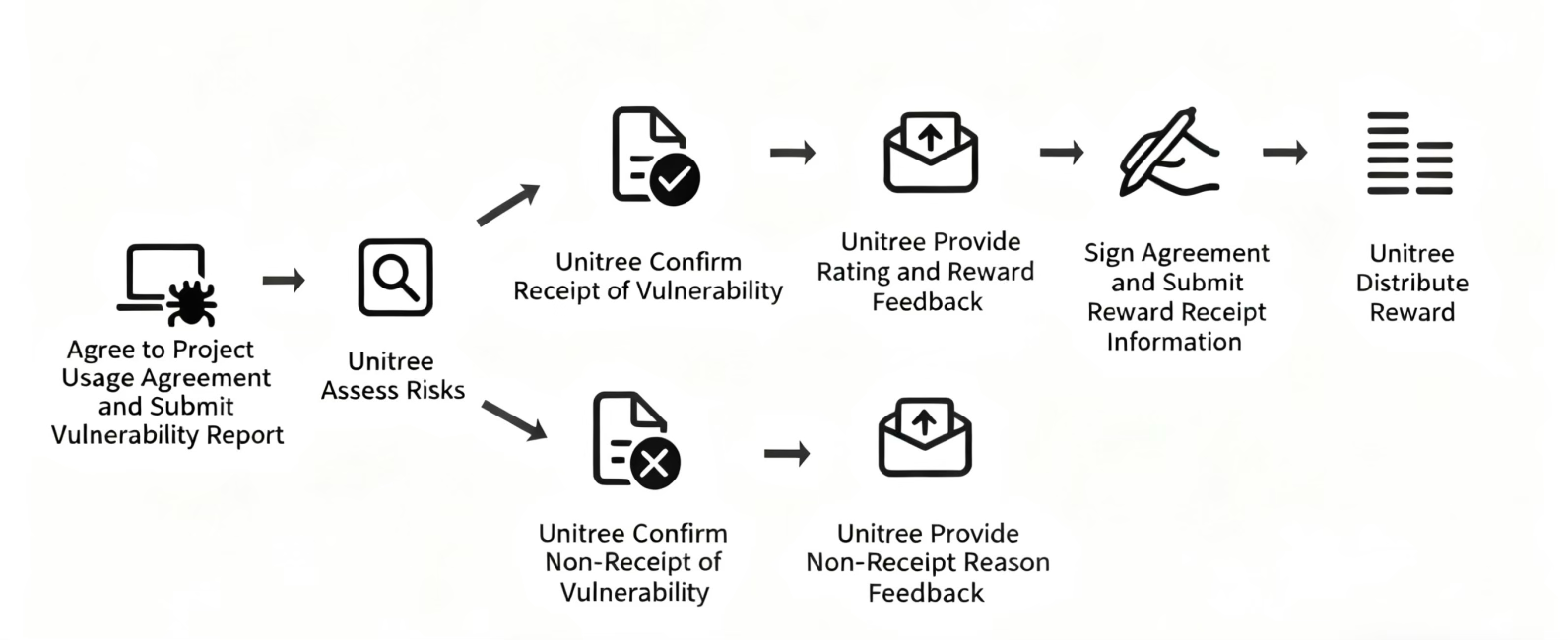
2.1 Reporting Stage
The reporter submits the vulnerability and threat information to Unitree through the designated platform or by sending an email to: [email protected].
2.2 Review Stage
1) A Unitree staff member will review the report and conduct a follow-up assessment within 1-2 business days.
2) The Unitree team will address the report within 3 business days, which includes reproducing the vulnerability, confirming its validity, and formulating a remediation plan.
3) If necessary, we will communicate with the reporter for confirmation and request their assistance.
2.3 Remediation Stage
The technical research and development department will fix the reported issue and schedule the deployment of the fix.
Remediation Timelines:
1) Critical/High/Medium severity vulnerabilities will be remediated within 90 business days.
2) Low severity vulnerabilities will be remediated within 180 business days. Please note that remediation may be subject to environmental or hardware constraints, and the actual repair time will be determined based on the specific circumstances.
2.4 Reward Confirmation and Distribution
After a vulnerability confirmed by Unitree has been verified as fixed for one month, it will enter the reward distribution phase.
1) The distribution frequency is tentatively set to once per quarter.
2) In special circumstances, Unitree staff will handle requests accordingly.
III. Vulnerability Rating
| Severity Level | Web Vulnerabilities | APP Vulnerabilities | Terminal Vulnerabilities (Robot/Dog) |
|---|---|---|---|
| Critical | 500$ ~ 1000$ | 500$ ~ 1000$ | 1000$ ~ 5000$ |
| High | 100$ ~ 500$ | 150$ ~ 600$ | 200$ ~ 1000$ |
| Medium | 50$ ~ 80$ | 50$ ~ 80$ | 100$ ~ 200$ |
| Low | 10$ ~ 50$ | 10$ ~ 50$ | 20$ ~ 100$ |
| No. | Importance Level | Description |
|---|---|---|
| 1 | Core Business | Platforms or websites involving payment, user sensitive information, sensitive orders, robots/dogs |
| 2 | General Business | Platforms or websites involving user operations, logistics data, general factory data, employee information |
| 3 | Peripheral Business | Platforms involving general operations, general OA information systems, etc. |
| Level | Content |
|---|---|
| Critical |
1. Vulnerabilities that directly grant access to core system permissions, including but not limited to: webshell upload, command execution, remote overflow, injection vulnerabilities, etc. 2. Vulnerabilities that can obtain sensitive information of a large number (100,000+) of Unitree users, including but not limited to: order enumeration, SQL injection, etc. 3. Payment-related vulnerabilities, including but not limited to: severe logic errors, vulnerabilities that can obtain significant benefits and cause losses to the company or users. 4. Vulnerabilities that endanger the Unitree account system: such as obtaining detailed user information through any account login, logging into the Unitree cloud to control robots/dogs, accessing user payment permissions, etc. |
| High |
1. Logic vulnerabilities in specific activities or services, such as point/promo credit farming, that can indeed obtain certain benefits. 2. Stored XSS/Injection in core systems, or vulnerabilities affecting up to 100,000 users in general applications. 3. Weak passwords or authentication bypass leading to backend access, with substantial permissions or access to sensitive information within the business context. 4. Vulnerabilities that can obtain sensitive information of a large number of users (100,000+) in bulk. 5. Source code leaks that could cause significant harm. 6. Highly destructive unauthorized access vulnerabilities affecting critical functions, such as editing or deleting orders. |
| Medium |
1. Leakage of a relatively smaller amount of user information (500 - 100,000 records). 2. Stored XSS/Injection in general systems. 3. Destructive unauthorized access vulnerabilities, such as editing/deleting comments, changing functional attributes, etc. 4. File inclusion, directory traversal, or vulnerabilities allowing viewing of sensitive information. 5. Source code leaks that disclose important information or contain exploitable vulnerabilities. 6. SSRF vulnerabilities capable of returning internal network information. 7. Vulnerabilities requiring user interaction to log into individual accounts, but which grant actual user operational permissions. |
| Low |
1. Leakage of small amounts of information, including but not limited to: debug information, phpinfo, SVN file leaks, GitHub exposures, test server credentials for internal employee networks, etc. 2. Vulnerabilities confirmed as valid but with significant exploitation difficulty. |
| None (Ignored) |
1. Vulnerabilities that cannot be reproduced after multiple communications with the submitter. 2. Reports that are overly simplistic, preventing problem identification and analysis. 3. Internally known vulnerabilities. |
| Level | Content |
|---|---|
| Critical |
1. Remote mass leakage/alteration of arbitrary user or robot/dog critical data. 2. Gaining client-side or server-side privileges through core APP vulnerabilities. |
| High |
1. Vulnerabilities enabling remote access to or tampering with user sensitive information, including but not limited to: command execution, code execution vulnerabilities. 2. Unauthorized access vulnerabilities leading to leakage/alteration of user or robot/dog important information. 3. Vulnerabilities affecting the normal operation of certain vehicle functions. |
| Medium |
1. Common unauthorized access vulnerabilities capable of causing harm to users under specific conditions. 2. General information leakage, including but not limited to: cleartext password storage in client. 3. Vulnerabilities requiring user interaction to obtain identity information, including but not limited to: stored XSS, reflected XSS, DOM-based XSS, CSRF affecting important sensitive operations. |
| Low |
1. Insecure configuration of the App. 2. Low-risk information leakage. 3. Vulnerabilities requiring complex, impractical environments or conditions to trigger. |
| None (Ignored) |
1. Vulnerabilities that cannot be reproduced after multiple communications with the submitter. 2. Reports that are overly simplistic, preventing problem identification and analysis. 3. Internally known vulnerabilities. |
| Level | Content |
|---|---|
| Critical |
1. Non-interactive remote control of any Robot/Dog function (remote attacks, including but not limited to vulnerabilities using Wifi, Bluetooth, Cellular networks, GPS, etc., as entry points leading to remote control). |
| High |
1. Remote control of partial Robot/Dog functions. 2. Remotely exploitable vulnerabilities leading to large-scale leakage of Robot/Dog sensitive information. 3. Physical-contact-based control of partial functions of a single Robot/Dog (disassembly does not constitute physical contact for this purpose). |
| Medium |
1. Restricted code execution achievable within the robot's domain under certain necessary conditions. 2. Remotely exploitable vulnerabilities for obtaining sensitive information, such as leakage of critical data, passwords, or configuration files (the final rating depends on the specific system architecture and business logic). 3. Persistent remote Denial-of-Service (DoS) attacks, e.g., vulnerabilities causing the Robot/Dog to malfunction permanently without an update, such as system crashes in a continuous loop. |
| Low |
1. Temporary remote Denial-of-Service (DoS) attacks, e.g., vulnerabilities causing temporary system function failure or requiring a system reboot to restore normal operation. 2. Minor information leakage vulnerabilities, e.g., debug information leaks. 3. Vulnerabilities that can only be triggered under extreme or highly specific conditions. 4. Local contact-based Denial-of-Service (e.g., via USB). |
| None (Ignored) |
1. Vulnerabilities that cannot be reproduced after multiple communications with the submitter. 2. Reports that are overly simplistic, preventing problem identification and analysis. 3. Internally known vulnerabilities. |
IV. Dispute Resolution

 EN